Cirl Bunting
Emberiza cirlus
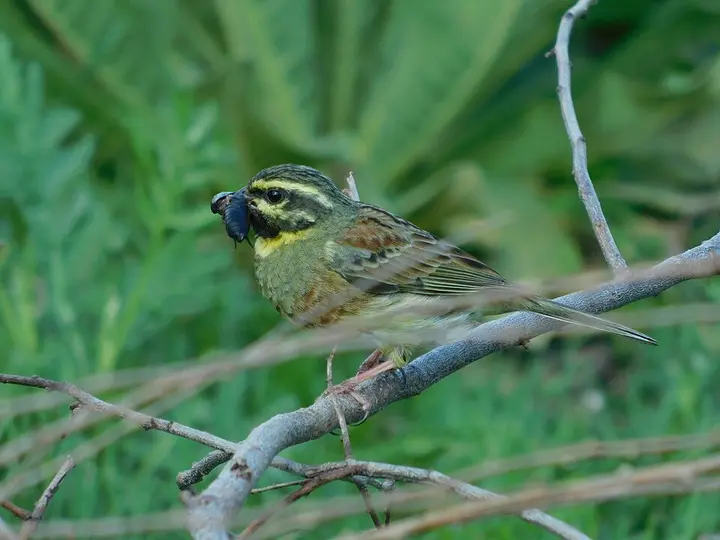
By sight
The male has a head striped black and yellow, a black throat and an olive-green band across the breast (16 cm). The female is streaky and yellowish brown.
It’s on my list: I’ve seen or heard it at some point.
By ear
A dry, metallic trill on a single note, “tsrrrrrr”, harder than the Western Bonelli’s Warbler’s.
When you hear it most: from February to August.

Recording: Anton Pigge, CC BY-SA 4.0. Trimmed to 10 s. Spectrogram from 0 to 10 kHz: time runs from left to right and high pitches are at the top.
Easily confused with
European Serin
The male Cirl Bunting also has a yellow head, but with a black throat and a black stripe through the eye, and it’s bigger and longer-tailed (16 cm). The Serin sings a fizz without pauses; the Cirl Bunting, a dry trill on a single note.
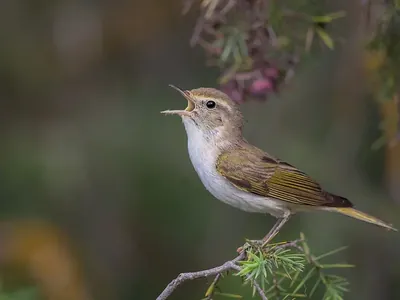
Western Bonelli’s Warbler
Easy to mix up by ear: both sing a trill on a single note. The Cirl Bunting’s is harder and more metallic and usually comes from a wire or the top of a bush; the Bonelli’s Warbler’s is shorter and softer, from the tops of pines and oaks.

- Page on SEO/BirdLifemore photos, a map and where it lives (in Spanish)
- More recordings on Xeno-cantosongs and calls from around the world